2026 update
Protecting families
from unsafe conduct on every ride
Zero tolerance
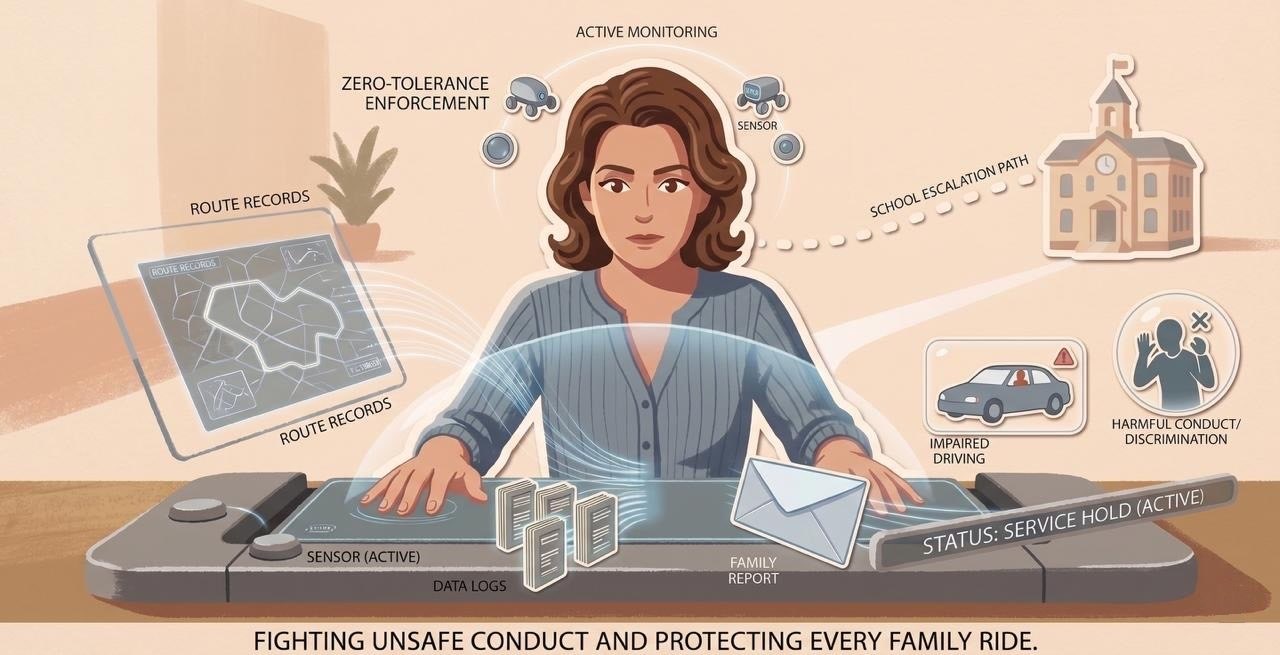
Buggy uses route records, monitoring tools, family reports, and school escalation paths to
identify impaired driving, harmful conduct, discrimination, or deliberate safety-protocol
bypassing before those issues are normalized as routine service problems.
Learn more in Trust & Safety
Using ride data
Route logs and support records help us reconstruct what happened and when.
Protecting privacy
We document safety facts without turning sensitive concerns into public records.
Acting early
High-risk concerns trigger immediate review, service holds, and documented escalation.
Our ongoing work
Keeping pickup authorization clear
Guardian permissions, route alerts, and support review reduce the chance that pickup changes are handled informally or without verification. When plans shift, Buggy expects the driver, caregiver, and support team to use the documented pickup record instead of relying on assumptions or verbal handoffs.
Helping families report concerns quickly
Direct support, trust resources, and school escalation paths make it easier to report concerns before they become pattern failures. Reports are documented in one review lane so the next action, owner, and follow-up status are visible instead of being lost in separate conversations.
Strengthening ride oversight
Vehicle readiness standards, route visibility, and in-vehicle monitoring create more than one way to spot unsafe behavior. Route records, driver check-ins, and school-facing service notes give Buggy a clearer timeline when a concern has to be reconstructed after the ride.
Refreshing training and conduct rules
Drivers and staff receive continuing guidance on student dignity, device restraint, caregiver communication, and escalation expectations. The goal is not only to react after a violation, but to reinforce the conduct standards that should keep harmful situations from starting.
Improving policy enforcement
Zero-tolerance issues can lead to immediate removal from service, partner notification, external reporting, or permanent ineligibility. When a case is substantiated, Buggy documents the decision path so families, schools, and internal operators are not left guessing what happened next.
Protecting children with additional needs
Accessibility and accommodation concerns are reviewed with the same child-first urgency as conduct, route, or handoff failures. Mobility, communication, and handoff accommodations should be documented before the next ride rather than improvised during pickup or drop-off.
Following up with families and schools
Buggy closes the loop with the caregivers, school teams, and care programs who need to understand whether service is continuing, paused, or under review. That follow-up is part of the safety work, not an afterthought once the immediate alert has passed.
Our commitment to every family
Families trust Buggy with curbside handoffs, afterschool transitions, and the expectation
that every child will be treated with patience and respect. Zero tolerance only works if it
is paired with clear reporting channels, visible operations, and the discipline to act early.
The Buggy Safety Commitment
Everyone who operates on Buggy is expected to treat children, families, school teams, and
coworkers with respect and without judgment, bias, intimidation, or retaliation.
I will treat everyone in the community—regardless of their race, religion,
national origin, ethnicity, skin color, disability, sex, gender identity,
sexual orientation, or age—with respect, and act quickly when something
feels unsafe.
Read the zero-tolerance policy
The full policy explains prohibited conduct, reporting channels, review steps, and the
conditions that can lead to service removal or external escalation.
View policy
If a child is in immediate danger, call 911.
For non-emergency concerns, use Buggy support, review
Trust & Safety, or
download the printable PDF.
Organizations we learn from
Buggy studies child-safety, passenger-safety, youth, and family-protection guidance from these
organizations. Their work informs our standards; it is not an endorsement or a formal partnership.